×
- Hello
- Login or Register
- Quick Links
- Live Chat
- Track Order
- Parts Availability
- RMA
- Help Center
- Contact Us
- Shop for
- Volvo Parts

My Garage
My Account
Cart
Genuine Volvo 740 Wheel Bearing
Hub Bearing- Select Vehicle by Model
- Select Vehicle by VIN
Select Vehicle by Model
orMake
Model
Year
Select Vehicle by VIN
For the most accurate results, select vehicle by your VIN (Vehicle Identification Number).
3 Wheel Bearings found

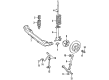
Volvo 740 Front Hub & Bearing Part Number: 271905
$232.60 MSRP: $276.90You Save: $44.30 (16%)Ships in 1-2 Business Days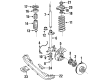
Volvo 740 Hub Assembly Part Number: 271644
$272.12 MSRP: $323.96You Save: $51.84 (16%)Ships in 1-2 Business Days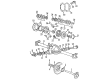
Volvo 740 Wheel Bearing Part Number: 384728
Volvo 740 Wheel Bearing
OEM parts are the only choice for top quality and real functionality. They pass strict checks, and they match Volvo's factory specs, so installation is easy. If you need new Wheel Bearing and you want quality and fit. You will find both here. Our site has a wide range of OEM Volvo 740 parts. The prices are unbeatable, allowing you to get value for money. Each genuine 740 Wheel Bearing comes with the manufacturer's warranty. That gives you peace of mind. We ship fast to your door. Order today, and enjoy a smooth, no-hassle upgrade with parts that fit right.
Volvo 740 Wheel Bearing Parts and Q&A
- Q:How to replace the wheel bearings and wheel hub on Volvo 740?A:The front wheel bearings on front drive vehicles are not adjustable and if the lateral amount of run-out on the hub with the disc removed is greater than 0.0007 inch (0.020mm) then the hub will need to be replaced. To remove and install components on 850, 870, C70 and V70 models, first raise and safely support the vehicle before removing the wheel. Disconnect the ABS sensor from the axle shaft without disconnecting the connector and hang it out of the way. Next, remove the caliper, carrier and rotor, making sure to hang the caliper safely. Proceed to remove halfshaft, separate Ball Joint from the Control Arm and disconnect the sway bar link. Remove the 4 bolts holding the hub and extract the hub. For installation, clean the axle shaft and the hub mating surface and clean the ABS sensor with a soft brush. Install the new hub, tightening the bolts one by one, to 33 ft. lbs. (45 Nm) + 60 degrees. Insert the axle shaft into the hub, fit the splines and tighten the new axle shaft nut by hand. Connect the ball joint to the control arm with new nuts and then connect the sway bar link. Install the brake rotor, carrier and caliper, tightening the axle nut to 89 ft. lbs. (120 Nm) plus an additional 60 degrees, using tool 5461 or an equivalent to counterhold, and lock the axle shaft nut with a chisel. Clean the ABS sensor and its seat and tighten the sensor to 84 inch lbs. (10 Nm) and then install the wheels and lower the vehicle.
- Q:How to check and service wheel bearings on Volvo 740?A:To check for wheel bearing play, lift the vehicle and support it safely then rock the wheel at the 12 and 6 o'clock positions, if there is movement the wheel bearing should be serviced. For noise inspection, hold up the wheel off the ground and spin it by hand to listen if there is any noise, if it is still noisy after adjustment, it requires the wheel bearing to be replaced. The front wheel bearings on rear drive vehicles are not adjustable and if the lateral run-out on the hub is greater than 0.0012 inch (0.030mm) with the disc removed, the hub should be replaced. To remove and install, the first step is to raise and support the vehicle, remove the wheel(s) and brake caliper, remembering to hang it safely. Pry off the grease cap, remove the cotter pin and castle nut and extract the hub and brake disc assembly, using a bearing puller if necessary. Carefully tap out the grease seal and inner bearing race, and remove the outer bearing race. For installation, press in new inner and outer bearing races and pack the wheel bearing with grease and make sure the inner bearing seal is in the correct location. For hubs having separate brake discs, push the sealing ring against the spindle and install the inner bearing and sealing washer. Reinstall hub, outer race, castle nut and adjust bearing pre-load by spinning hub while tightening center nut to 42 ft. Ib (57 Nm), loosening half turn, tightening by hand to 12 inch lbs. (1.4 Nm). Install the cotter pin, making sure it is aligned with the spindle, then the protective cap, brake caliper, wheel and, finally, lower the vehicle.
Related Volvo 740 Parts
 Volvo 740 Axle Beam Mount
 Volvo 740 Axle Pivot Bushing
 Volvo 740 Ball Joint
 Volvo 740 Front Cross-Member
 Volvo 740 Shock and Strut Boot
 Volvo 740 Strut Housing
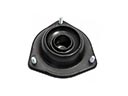 Volvo 740 Strut Mounts
 Volvo 740 Sway Bar Bushing
 Volvo 740 Sway Bar Link
 Volvo 740 Sway Bar Link Bushing
 Volvo 740 Wheel Hub
 Volvo 740 Wheel Seal